
What Does Shitsurei Shimasu (失礼します) Mean? — How to Use It in Japanese
Learn what shitsurei shimasu (失礼します) means, when to say it, and how it differs from sumimasen in Japanese everyday conversations.
You knock on a door before entering a room in Japan.
Someone inside says, “Come in.”
As you open the door, you say:
失礼します (Shitsurei shimasu).
You may hear the same expression when someone leaves an office, interrupts a conversation, or finishes a phone call.
But what does it actually mean?
Although shitsurei shimasu is often translated as “Excuse me,” its meaning goes a little deeper.
Let's explore how this useful Japanese expression works in everyday life.
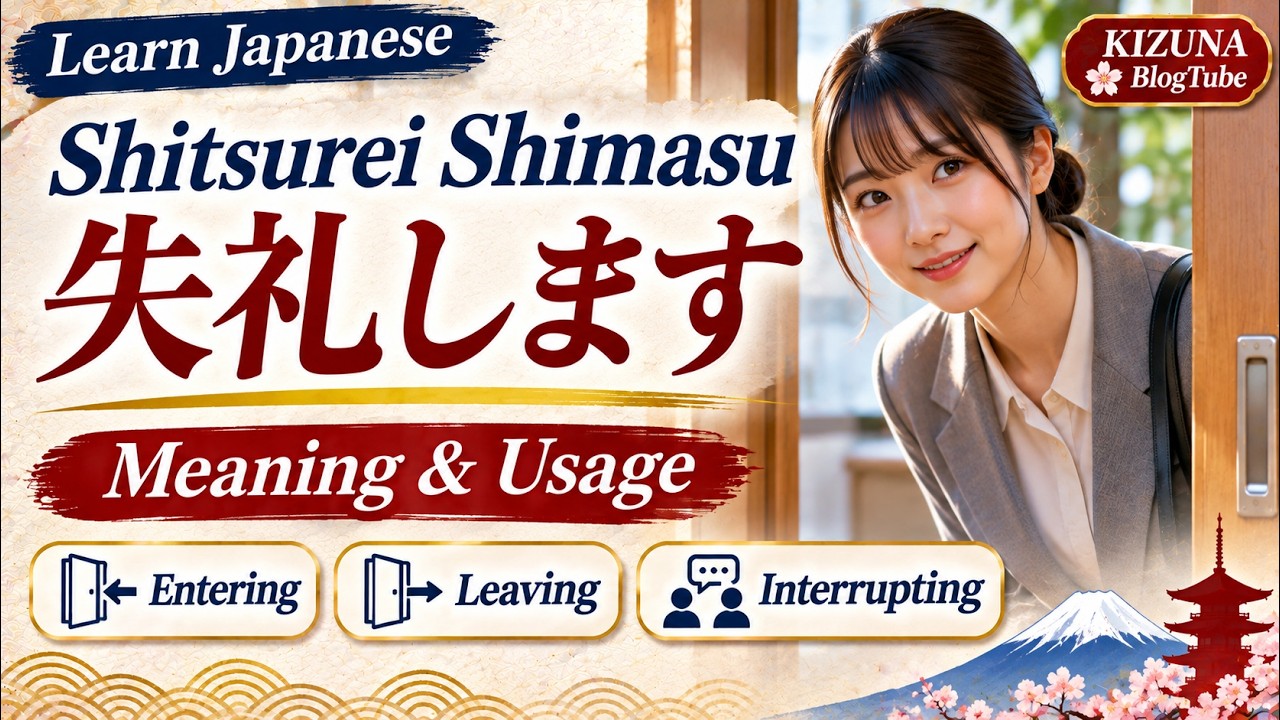
1. What Does Shitsurei Shimasu Mean?
失礼します (Shitsurei shimasu) is a polite Japanese expression commonly translated as:
- Excuse me.
- Pardon me.
- Please excuse me for leaving.
- Excuse me for interrupting.
The exact English translation depends on the situation.
The expression consists of two parts:
失礼 (Shitsurei) — Rudeness, discourtesy, or a breach of etiquette.
します (Shimasu) — The polite form of the verb meaning “to do.”
A literal interpretation might sound like “I am going to be rude.”
However, Japanese speakers do not usually understand it as an admission of actual rudeness.
Instead, it politely acknowledges that an action may interrupt someone, enter their personal space, or require their attention.
It is a small expression of consideration for another person.
2. When Do Japanese People Say Shitsurei Shimasu?
One useful thing about shitsurei shimasu is that it appears in several different everyday situations.
Situation 1: Entering a Room
Imagine visiting a teacher's office or entering a meeting room.
After knocking and receiving permission to enter, you might say:
失礼します。
Shitsurei shimasu.
“Excuse me.”
This is one of the most common situations in which you will hear the expression.
It acknowledges that you are entering a space where someone else is already present.
Example conversation
A: どうぞ。
Dōzo.
“Come in.”
B: 失礼します。
Shitsurei shimasu.
“Excuse me.”
This short exchange is useful at school, at work, and in other relatively formal situations.
Situation 2: Leaving a Room or Meeting
Shitsurei shimasu is not only used when entering.
It can also be used when leaving a room, finishing a visit, or departing from a formal meeting.
Example
失礼します。ありがとうございました。
Shitsurei shimasu. Arigatō gozaimashita.
“Excuse me. Thank you very much.”
Here, the expression politely signals that you are about to leave.
The same Japanese words can therefore be used both when entering and when leaving.
The situation gives them their meaning.
Situation 3: Interrupting a Conversation
Imagine two coworkers are talking, but you need to ask one of them an important question.
Instead of immediately interrupting, you might begin with:
失礼します。少しよろしいでしょうか。
Shitsurei shimasu. Sukoshi yoroshii deshō ka.
“Excuse me. May I have a moment?”
This sounds polite and considerate.
The speaker recognizes that the other person may be busy or engaged in something else.
In everyday casual situations, people may choose simpler expressions such as sumimasen instead.
Situation 4: Ending a Phone Call
You may also hear shitsurei shimasu near the end of a polite telephone conversation.
Example
それでは、失礼します。
Sore dewa, shitsurei shimasu.
“Well then, goodbye.”
In this situation, it serves as a respectful way to end the conversation.
This is particularly common in professional or formal communication.
3. What Does Osaki ni Shitsurei Shimasu Mean?
There is another very useful expression that you may hear in Japanese workplaces.
お先に失礼します。
Osaki ni shitsurei shimasu.
“Excuse me for leaving before you.”
Imagine your working day has finished, but some of your coworkers are still at their desks.
As you leave, you might say:
お先に失礼します。
Someone staying behind may reply:
お疲れさまでした。
Otsukaresama deshita.
A natural English interpretation is “Good work today.”
The word osaki (お先) means “ahead” or “before others.”
Adding it to shitsurei shimasu acknowledges that you are leaving before the other people.
It does not necessarily mean that leaving first is wrong.
Rather, it is a conventional, polite way to announce your departure and recognize the people who remain.
4. Shitsurei Shimasu vs. Sumimasen — What's the Difference?
Japanese learners often notice that both expressions can be translated as “Excuse me.”
However, their typical uses are different.
| Expression | Main use |
|---|---|
| 失礼します (Shitsurei shimasu) | Politely entering, leaving, or interrupting |
| すみません (Sumimasen) | Apologizing, getting attention, or making a request |
For example, when calling a restaurant employee, you would naturally say:
すみません!
Sumimasen!
“Excuse me!”
But when entering a teacher's office, 失礼します is often more appropriate.
Both expressions show politeness, but they are not always interchangeable.
A helpful way to remember the difference is:
Sumimasen often asks for someone's attention or expresses an apology.
Shitsurei shimasu often politely acknowledges the action you are about to take.
5. Shitsurei Shimasu vs. Shitsurei Shimashita
You may have heard another similar expression:
失礼しました (Shitsurei shimashita).
What is the difference?
The key is the verb tense.
失礼します (Shitsurei shimasu)
Used when you are about to do something, such as entering a room or interrupting someone.
失礼しました (Shitsurei shimashita)
Used to acknowledge something that has already happened, such as an interruption or mistake.
Example
あ、失礼しました。
A, shitsurei shimashita.
“Oh, excuse me. I'm sorry.”
Imagine accidentally entering the wrong room.
You might use shitsurei shimashita after realizing your mistake.
However, Japanese is flexible, and both expressions can appear when leaving a room, depending on the situation.
The distinction is useful, but it is not an absolute rule for every conversation.
6. Is Shitsurei Shimasu Formal or Casual?
Shitsurei shimasu is a polite expression.
You will commonly hear it in workplaces, schools, meetings, and other situations where polite language is appropriate.
Among close friends or family members, it can sound unnecessarily formal.
For example, when leaving a friend's house, you might simply say:
じゃあ、またね。
Jā, mata ne.
“See you later.”
When visiting someone's home, another common expression is:
お邪魔します。
Ojama shimasu.
“Excuse me for coming in.”
The expressions are related in spirit, but they belong to different situations.
You do not need to say shitsurei shimasu every time you enter or leave somewhere.
Learning when to use an expression is just as important as remembering its translation.
7. Practice: Choose the Right Expression
Let's try three short situations.
Question 1
You are entering your teacher's office.
What would you say?
Answer: 失礼します。 (Shitsurei shimasu.)
Question 2
You are leaving work while your coworkers are still working.
What would you say?
Answer: お先に失礼します。 (Osaki ni shitsurei shimasu.)
Question 3
You want to get a restaurant employee's attention.
What would you say?
Answer: すみません。 (Sumimasen.)
These three situations show why understanding context makes Japanese expressions easier to use naturally.
8. A Small Expression of Consideration
In Japanese communication, politeness is not always about apologizing for something wrong.
Sometimes, it is simply about acknowledging another person's presence, time, or space.
Shitsurei shimasu is one example.
It may be spoken before entering a room, interrupting a conversation, or leaving a workplace.
The words themselves remain the same, but their meaning changes slightly with the situation.
And while the expression is commonly associated with formal settings, the consideration behind it is not limited to business etiquette.
It reflects one way that Japanese speakers manage everyday interactions.
Understanding that background helps the words feel less like a phrase to memorize and more like a natural part of communication.
9. Final Thoughts
失礼します (Shitsurei shimasu) is a small expression with several practical uses.
You can use it to enter a room politely, excuse yourself from a meeting, interrupt someone respectfully, or end a formal conversation.
You may also encounter related expressions such as osaki ni shitsurei shimasu and shitsurei shimashita.
Rather than trying to find one perfect English translation, pay attention to the situation in which the words are spoken.
That is often the best way to understand Japanese naturally.
Explore more Japanese words and everyday expressions with KIZUNA — Connecting with Japan.
For another Japanese expression that is difficult to translate directly, read What Does Natsukashii Mean? — Japanese Nostalgia.
Continue Exploring Japan with KIZUNA
Japanese words often carry shades of meaning that are difficult to express in a single English translation.
Explore the language, everyday expressions, and ideas behind the words on our Japanese Learning Blog.
The Kizuna Connecting with Japan channel shares quiet videos about the habits, customs, and small details of life in Japan.
Explore the Everyday Japan series to discover more.

KIZUNA BlogTube turns our Japanese culture and language articles into videos with clear English narration and simple visuals.
Explore more narrated articles through the channel's playlists.

Explore Japanese ways of seeing through quiet digital reading from KIZUNA.
Featured booklet: Wabi-Sabi – already in your life (Full Edition), a bilingual reflection on imperfection, age, and everyday beauty.



 Posts


No comments:
Post a Comment